About Rosemary Essential Oil
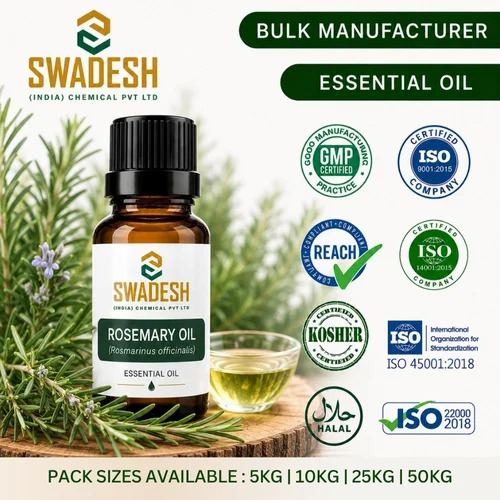
Rosemary Oil is a natural essential oil obtained from the leaves and flowering tops of Rosmarinus officinalis (now classified as Salvia rosmarinus) through steam distillation. It is widely used in hair care products, cosmetics, personal care formulations, aromatherapy, pharmaceuticals, and wellness products due to its fresh, herbal, and camphoraceous aroma.
Product Information:
- Product Name: Rosemary Essential Oil
- Botanical Name: Salvia rosmarinus (Rosmarinus officinalis)
- Common Name: Rosemary Oil
- Plant Part Used: Leaves and Flowering Tops
- Extraction Method: Steam Distillation
- Appearance: Clear, Colorless to Pale Yellow Liquid
Colour:
Colorless to Pale Yellow
Odour:
Fresh, Herbal, Camphoraceous, Woody, Characteristic Rosemary Aroma
Key Features:
- Natural Essential Oil
- Fresh Herbal Aroma
- Excellent Blending Properties
- Widely Used in Hair Care Products
- Suitable for Cosmetic & Personal Care Applications
- Popular Ingredient in Aromatherapy
Applications:
- Hair Oils
- Hair Serums
- Shampoos & Conditioners
- Skin Care Products
- Aromatherapy Blends
- Massage Oils
- Soaps & Bath Products
- Personal Care Products
- Fragrances
Active Components:
- 1,8-Cineole (Eucalyptol) Major Active Component
- Camphor
- -Pinene
- Borneol
- Bornyl Acetate
- Camphene
- Limonene
- Verbenone (varies by chemotype)
Major Active Components:
- 1,8-Cineole: 1555%
- Camphor: 525%
- -Pinene: 1025%
Active Component (for Product Listing):
1,8-Cineole (Eucalyptol) is the primary active constituent and key quality parameter of Rosemary Oil.
Product Specifications:
- Botanical Name: Salvia rosmarinus
- Plant Part Used: Leaves & Flowering Tops
- Colour: Colorless to Pale Yellow
- Odour: Fresh, Herbal, Camphoraceous
- Major Active Component: 1,8-Cineole
- Shelf Life: 24 Months
Packaging:
Available in 1 kg, 5 kg, 25 kg, and 50 kg packing. Customized packaging available upon request.
HSN Code:
330129 (Essential Oils)
Nutrients / Bioactive Compounds:
- 1,8-Cineole (Eucalyptol)
- Camphor
- -Pinene
- Borneol
- Natural Antioxidants
- Terpenes
Plant Part Used: Leaves and Flowering Tops.
Powerful Natural ExtractionOur Rosemary Essential Oil is obtained via steam distillation, ensuring high purity and preservation of bioactive compounds. This careful process maintains the integrity and natural fragrance of rosemary, making the oil effective for a variety of uses-whether for skincare, wellness, or aromatherapy.
Versatile Uses Across All AgesThis oil is gentle and safe for all age groups, including infants, children, adults, and seniors. Valued for its diverse applications such as pain relief, mood enhancement, and skin care, Rosemary Essential Oil is suitable for both personal and professional use. Its solubility in alcohol and oils allows for easy incorporation into custom blends.
FAQ's of Rosemary Essential Oil:
Q: How should I use Rosemary Essential Oil for pain relief?
A: You can dilute Rosemary Essential Oil with a carrier oil and apply it topically to areas experiencing discomfort. Gently massage the oil into the skin to help relieve muscle or joint pain.
Q: What is the correct method to store Rosemary Essential Oil for maximum shelf life?
A: Store the oil in a cool, dry place, away from direct sunlight and moisture, to maintain its freshness and effectiveness for up to 24 months.
Q: When is the best time to use Rosemary Essential Oil for boosting memory?
A: For cognitive enhancement, use Rosemary Essential Oil during study sessions or before activities that require focus. Inhalation through a diffuser or direct inhalation is recommended before engaging in tasks that demand mental clarity.
Q: Where does the Rosemary Essential Oil come from and how is it manufactured?
A: This oil is produced in India using the steam distillation process, which extracts the essential compounds from fresh rosemary leaves, ensuring 100% natural purity.
Q: What are the benefits of using Rosemary Essential Oil on the skin?
A: Rosemary Essential Oil helps in reducing pigmentation and supports a clearer complexion. Always dilute it before topical use and patch test to avoid sensitivity, especially in sensitive individuals or children.
Q: How is the solubility of Rosemary Essential Oil useful for formulation?
A: Its solubility in alcohol and other oils makes it highly convenient for blending into massage oils, fragrances, or homemade cosmetic preparations, ensuring easy incorporation without separation.
 Gujarat, India
 Mon-Sat 9.00 AM - 6.00 PM













 Send Inquiry


 Send Inquiry
 Send SMS
 English
 Spanish
 French
 German
 Italian
 Chinese (Simplified)
 Japanese
 Korean
 Arabic
 Portuguese